
But some plans are made already for the next season...
30 Jun 2010
27 Apr 2010
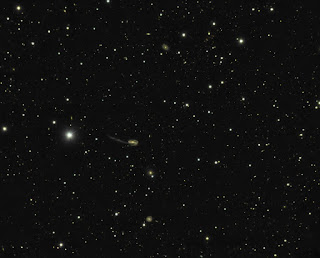
M86 and friends
I imaged this one at the end of March but the data was so poor that I almost threw everything away... There was quite a lot of high clouds which brought huge gradients to all channels.
Here's 2h of luminance and 20:30:30 min of RGB.

Here's 2h of luminance and 20:30:30 min of RGB.

20 Apr 2010
Arp 188 final
I decided to end the season 2009-2010 with this one so I gave it more light. Last two nights I took some more blue and quite a lot of Luminance.
So here it is!!

This one has 7h 20min (22*20min) of Luminance and 2h 35min of RGB (50:50:55 binned 2*2, 5min subs).
I added all the luminance data to next one and processed that without deconvolution which gave much softer result. This one has 11h 10min of luminance and 2h 35min RGB.
I'm not sure which one is better so I let viewer to decide...
So here it is!!

This one has 7h 20min (22*20min) of Luminance and 2h 35min of RGB (50:50:55 binned 2*2, 5min subs).
I added all the luminance data to next one and processed that without deconvolution which gave much softer result. This one has 11h 10min of luminance and 2h 35min RGB.

I'm not sure which one is better so I let viewer to decide...
14 Apr 2010
Arp 188: Tadpole galaxy
This season is about to end and I think this will be one of my last images for 2009-2010.
This faint (mag 14.4) barred spiral galaxy is located in constellation Draco and is located about 400 million light years away. Its most dramatic features are a trail of stars about 280 thousand light-years long.
First night I got about 4h30min of exposure but not a single usable frame of blue. But I was lucky and was able to image blue channel the next day, just before clouds arrived. But I got only 30min which really isn't enough for this object.

Total exposure of this image is 6hrs: L=2*15min+20*10min, RG=10*5min, B=6*5min (RGB binned 2*2)
Here's only L-channel, 3h 50min

This faint (mag 14.4) barred spiral galaxy is located in constellation Draco and is located about 400 million light years away. Its most dramatic features are a trail of stars about 280 thousand light-years long.
First night I got about 4h30min of exposure but not a single usable frame of blue. But I was lucky and was able to image blue channel the next day, just before clouds arrived. But I got only 30min which really isn't enough for this object.

Total exposure of this image is 6hrs: L=2*15min+20*10min, RG=10*5min, B=6*5min (RGB binned 2*2)
Here's only L-channel, 3h 50min

27 Mar 2010
SkyWatcher ED80 Pro
I just noticed that there's no proper picture of my imaging setups. So here's the one with smaller scope:

From left: QHY9, QHY filter wheel with Astronomik's HaLRGB filters, TS 9mm OAG with Atk314e, WO 0.8 reducer and finally the ED 80Pro with Robofocus. The mount is EQ-6 SynTrek.

From left: QHY9, QHY filter wheel with Astronomik's HaLRGB filters, TS 9mm OAG with Atk314e, WO 0.8 reducer and finally the ED 80Pro with Robofocus. The mount is EQ-6 SynTrek.
24 Mar 2010
NGC5907
This spiral galaxy was my next target. It is located approximately 39 million light years away.
Total exposure of the image is 8h 15min (L=5h 50min, RGB=50:40:55).

Total exposure of the image is 8h 15min (L=5h 50min, RGB=50:40:55).

18 Mar 2010
M101; Pinwheel Galaxy
This is another part of my two-night project. In both nights I started with M65&M66 and after 3-4 hours of imaging continued with this one.
This can be found in constellation Ursa Major and lies about 27 million light years away. With a diameter of 170000 light years it's nearly twice the size of the Milky Way (our own galaxy).

Picture have a total exposure of 5h 35min (L=8*10min+9*15min, RGB=8*5min each, bin2*2)
This can be found in constellation Ursa Major and lies about 27 million light years away. With a diameter of 170000 light years it's nearly twice the size of the Milky Way (our own galaxy).

Picture have a total exposure of 5h 35min (L=8*10min+9*15min, RGB=8*5min each, bin2*2)
Subscribe to:
Posts (Atom)
